What happens?
The report takes hours. The handoff breaks. A process is frustrating. Record what the buyer said and how they know.

Turn discovery notes into a case your buyer can use: the evidence, the open questions and the next decision.
The Three-Layer Playback system from BowTiedDingo.
One-time purchase · Starter from $37 · 14-day refund promise
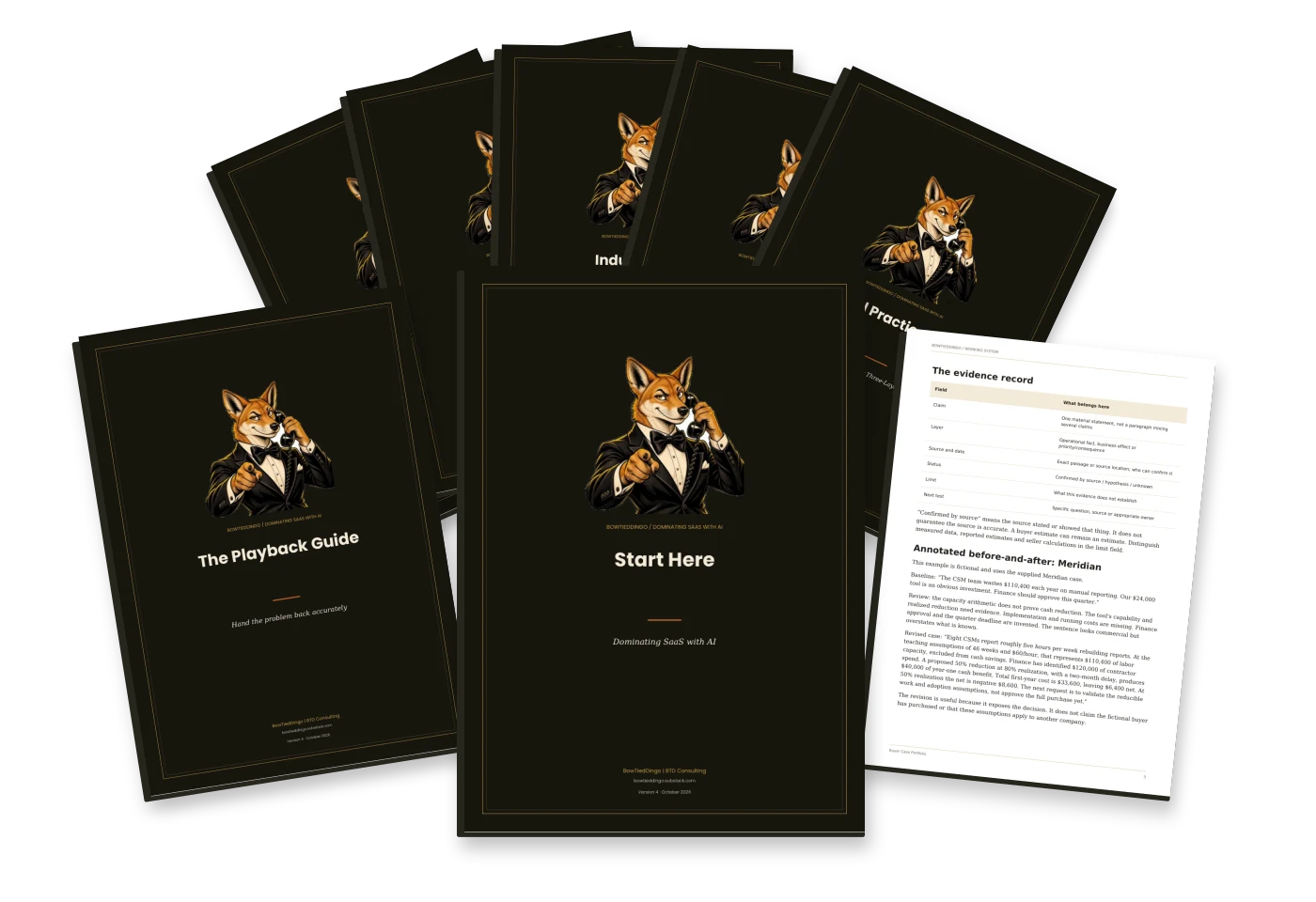
Operational facts. Business effects. A reason to act.
Keep the buyer's confirmation attached to every connection.
Your contact likes the demo. The problem sounds real. The follow-up is clear and professional.
Then comes “we'll discuss it internally.”
You can ask for an update. You can ask AI to write a better version. But neither tells you what the buying group needs to decide, or whether your contact has a useful case to take to them.
This is where a polished opportunity can hide an untested assumption.
Read the sales presentation · Inspect the free worked example
You can stop at the operational complaint. Or leap to a business consequence the buyer never confirmed. Both leave a gap in the case.
The report takes hours. The handoff breaks. A process is frustrating. Record what the buyer said and how they know.
Investigate the effect on cost, capacity, revenue or commitments. A plausible effect stays a hypothesis until there is evidence.
Check the priority, consequence and decision ownership. Your quarter-end date does not become the buyer's deadline.
AI can make a guess sound convincing. A qualification framework can give it a field. Neither makes it true.
Anchor in their words. Connect the established facts. Deepen with the question you still need answered. Check your understanding.
“You said the outside team gets pulled in when reporting runs late. Which part of that spend could actually change if the reporting work improved?”
Now the buyer can confirm the connection, change it or tell you it is not a problem worth pursuing.
Prepare that move. Rehearse it. Use it in the appropriate conversation. Update the case with what you learn.
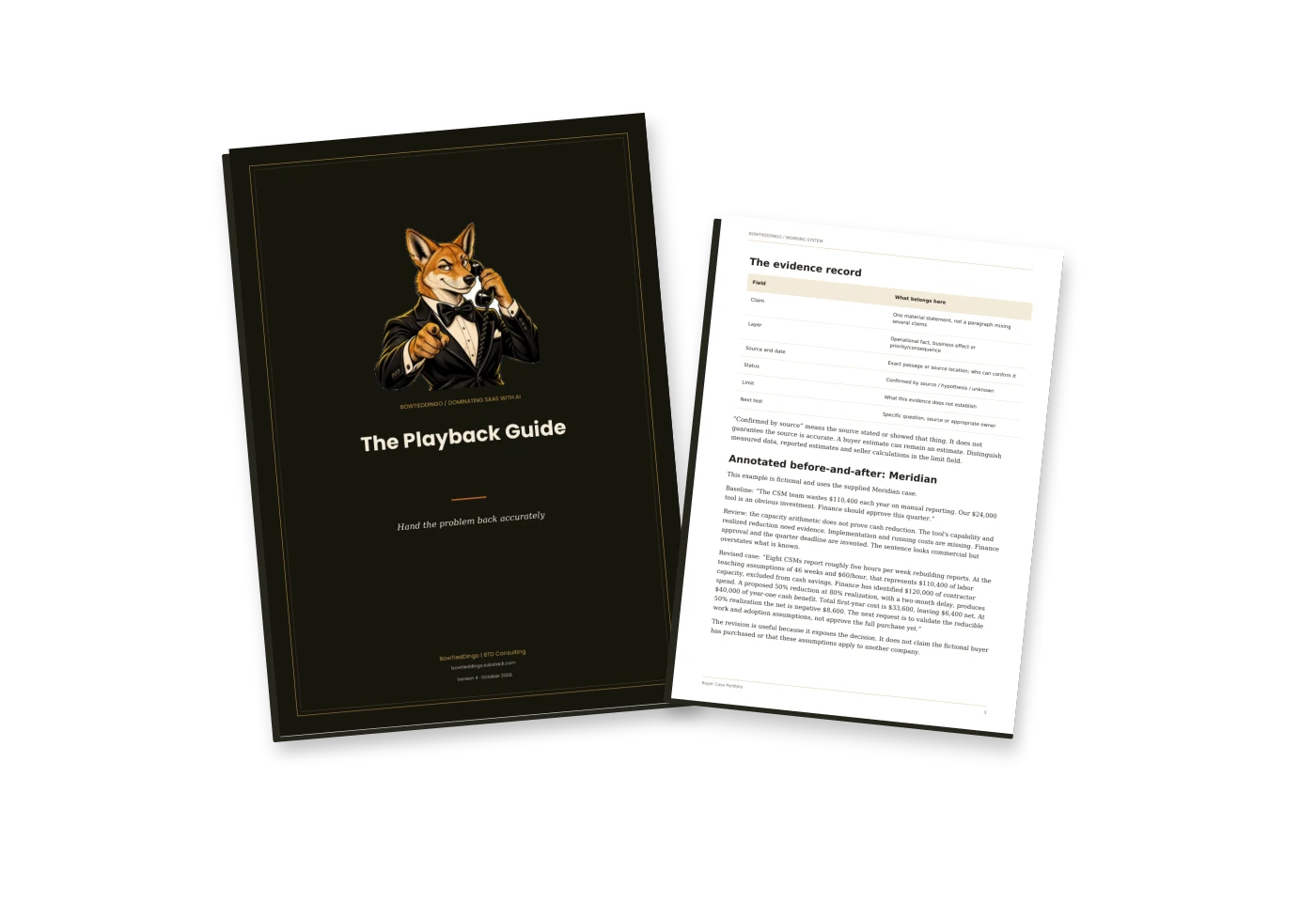
Written guides, reusable AI instructions and offline tools. Personal coaching and live-call software are separate.
In the anonymised Meridian case: eight CSMs spend five hours a week rebuilding reports. At the teaching assumptions, that represents $110,400 of labor capacity.
A weak draft calls it cash savings. The corrected case asks what spending actually changes.
After including contractor assumptions, adoption, a two-month delay and the full first-year costs, the base case is $6,400 positive. The downside is $8,600 negative.
The next move is to validate the assumptions with Finance. That is a more useful decision than pretending the purchase has already paid for itself.
Meridian is a anonymised real deal — names changed, not a customer result.
Pick one buyer statement, one assumption and the question that separates them. Then follow seven assignments using the same opportunity.
| Assignment | What you produce |
|---|---|
| 1. Establish the evidence | Buyer statements, sources, hypotheses and unknowns |
| 2. Prepare the conversation | A question that could change your next move |
| 3. Rehearse Playback | A first attempt, critique and improved retry |
| 4. Apply when appropriate | A real buyer response, or a clearly labeled practice attempt |
| 5. Update the case | What changed, who must agree and what remains open |
| 6. Build the buyer material | A one-pager or financial case with visible assumptions |
| 7. Review the decision | Continue, investigate, pause or disqualify—with a reason |
The suggested seven-day path is a work sequence. Your buyer may need longer. Use Meridian if you do not have suitable material to share.
Meridian makes you separate capacity from cash, expose assumptions and preserve a negative downside case.
Cadence makes you test internal support, correct a seller-created deadline and ask for the right decision.
Hearthline makes you accept a small problem that does not justify the product. The buyer never reveals a convenient hidden crisis.
All three are annotated anonymised cases. The twelve-station Deal Practice Lab gives you tasks, answer standards, common errors and retries. The Buyer Case Portfolio keeps your before/after work visible. You can practice with an approved AI tool or a colleague.
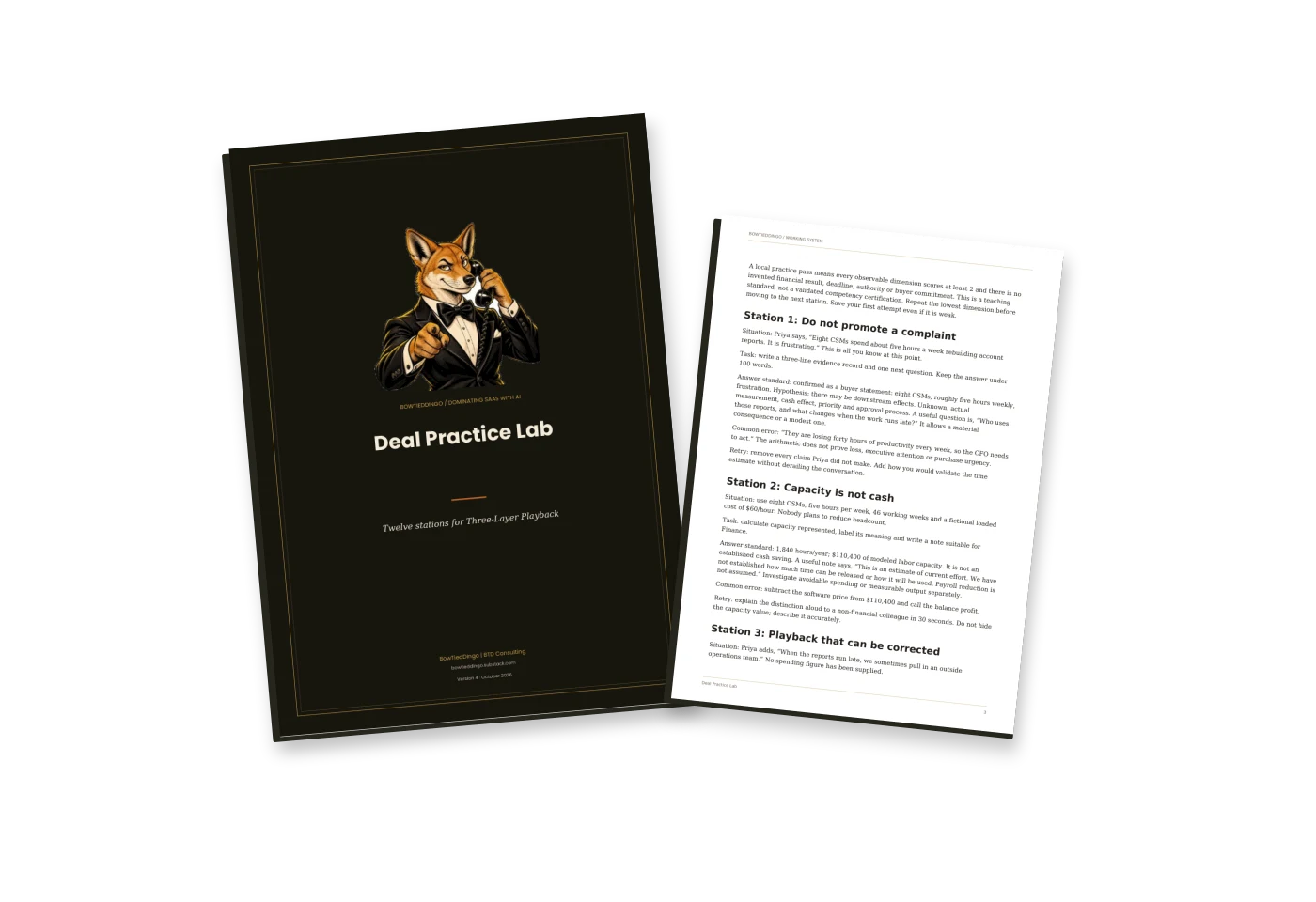
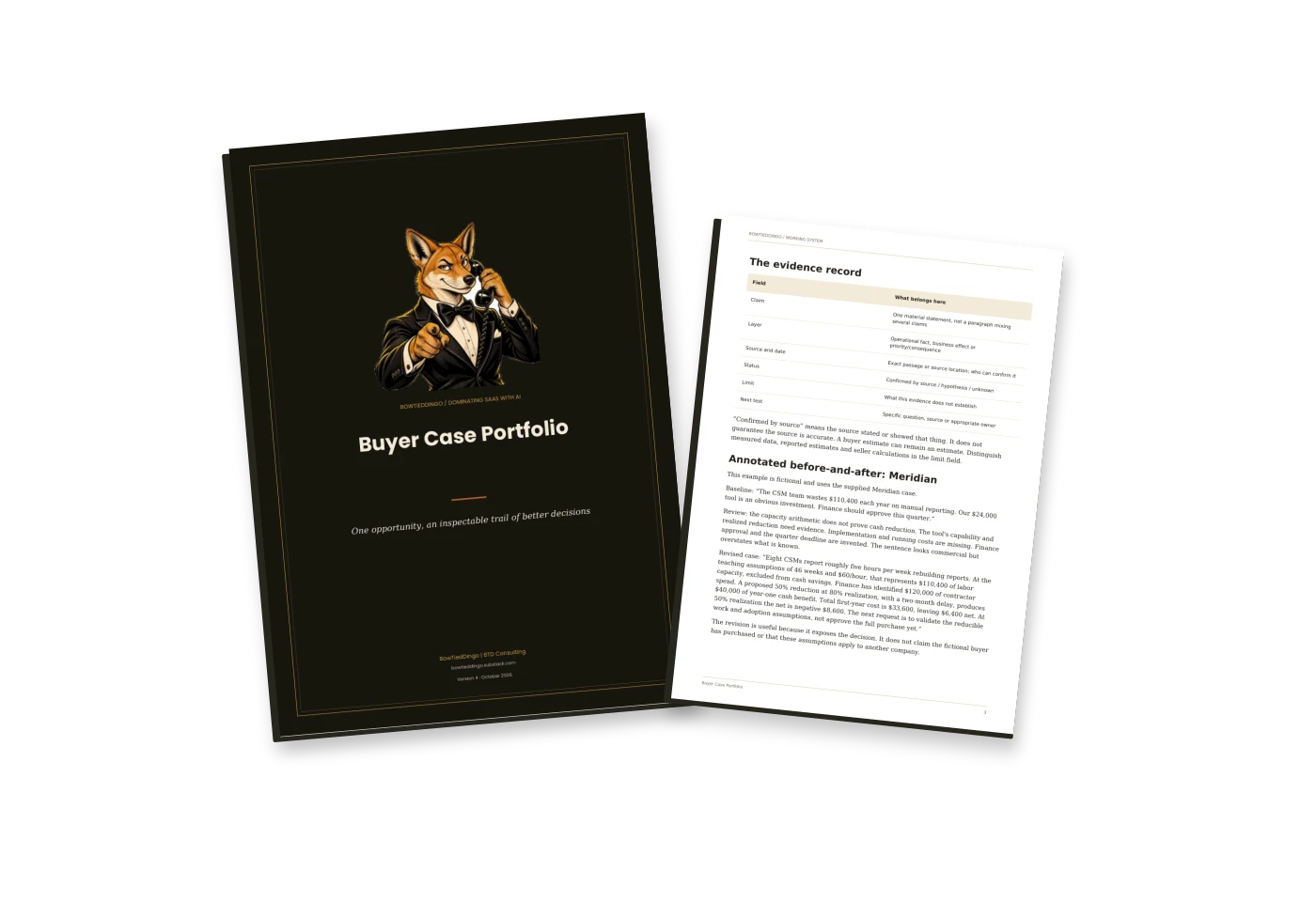
You are paying for the structured path and the tools to use it. The free example lets you judge that value for yourself.
A good call gives you more than notes.
You know what the buyer actually said. You can see where you're filling in the gaps. And you have a question that helps you find out whether the problem matters enough to act on.
That's the work Dominating SaaS helps you practise.
Start with one opportunity. Work through the buyer's evidence. Rehearse the conversation. Then build a case you can take back to the buyer and improve together.
You get the sequence, worked examples, answer standards and tools in one place, so you can spend your time working on the opportunity in front of you.
Starter — work through your first opportunity.
Begin with a ten-minute exercise: one buyer statement, one tempting assumption and one question that tests it. Then follow the complete path through preparation, Playback, your next conversation and a draft business case. The Meridian case shows what that work looks like, including where an attractive number needs to be challenged.
Complete — practise when the situation gets harder.
Work through a buyer who agrees but cannot secure a decision, a financial case that changes under scrutiny, and an opportunity that may not deserve another follow-up. Use the twelve-station practice lab, deeper discovery work and recurring deal routines to compare attempts and improve the next one.
Choose Starter if you want the first-opportunity path. Choose Complete if you want the wider practice system now.
Your verified Starter payment is credited if you upgrade later, so the total reaches the same $197 Complete price before applicable tax.
Complete includes Starter. Both are one-time digital purchases for one named user, with the same 14-day refund promise.
Build the first case, then practice the difficult situations and repeat the method.
One individual license. No subscription, required add-on or promised future content.
Founding price through October 13, 2026 at 11:59 p.m. Eastern. Then $47.
Standard price. Ongoing use of the purchased version.
A complete first-opportunity workflow. Upgrade later with your verified Starter payment credited toward the $197 Complete total.
Any applicable tax is shown before payment. Digital access follows payment confirmation. An AI platform subscription, personal Dingo feedback and live-call software are not included.
If the digital materials are not right for you, email btdingo@gmail.com within 14 days of purchase for a refund. No closed deal, score or completed exercise is required.
Read the refund termsI write Dominating SaaS about the work underneath the result: understanding the problem, checking the consequence and helping someone make a decision.
This system puts that work into a path you can use. Bring one opportunity. Keep the evidence. Practice the conversation. Let the answer change your next move.
— Dingo
Read Dominating SaaS on SubstackKeep your methodology. This helps you work with the evidence behind your qualification judgments and rehearse the next useful conversation.
Yes. The paid value is the organized method, annotated cases, practice standards, workbooks and tools around the prompts. Inspect the free example to judge whether that structure is useful to you.
Start with one statement and one question. Use the guides when the opportunity needs them. The first completion standard is an inspectable case and next move, not reading every file.
Yes. Begin with the anonymised case or practice with a colleague. For real work, use only information and AI tools your employer permits. The manual instructions are the baseline.
No. Starter covers the full first-opportunity path. Complete adds depth, more case situations and repeatable practice. A verified $37 Starter payment means a $160 upgrade; a $47 payment means $150. Either way the total is $197 before applicable tax.
No. The rubric reviews the supplied attempt. It is not a validated forecast, certification or substitute for buyer evidence.
The digital products include self-guided practice, examples and answer standards. Personal feedback from me is available through separate paid coaching and team training engagements. Start with the relevant application. If there is a fit, we invite you to a review and explain the engagement and investment. You can use the digital products independently.
Use the 14-day digital refund promise. Email support within the window. Services have separate written terms agreed before payment.
A digital purchase is not required. Start with the review that fits your role.
Work on the moment you keep getting stuck. Bring a recurring challenge to a Deal Practice Review. We will identify a useful focus and your first practice step, then discuss coaching if relevant.
Apply for a Deal Practice ReviewGive your team a standard managers can reinforce. Start with a Team Execution Review to examine a recurring execution problem and a useful training priority.
Apply for a Team Execution ReviewFind the assumption. Practice the question. Build a case the buyer can check.
One-time digital purchase. 14-day refund promise.
Before you go
Not ready? Read the free Meridian worked example first — the $6,400 case that got smaller as it got better.
Or skip to checkout · 14-day refund promise on everything.