
Paid content
The business case got stronger when the savings number got smaller
A $110,400 ROI slide fell apart on one question — and the smaller number that replaced it.
Paid content from BowTiedDingo — I sell the training this points to. The company, people and figures below are a anonymised real deal — names changed, not customer results.
You know that deal — the one sitting in your forecast right now. Good conversations, friendly champion, a follow-up you already rewrote twice. And no reason you could defend for why it closes this quarter instead of next.
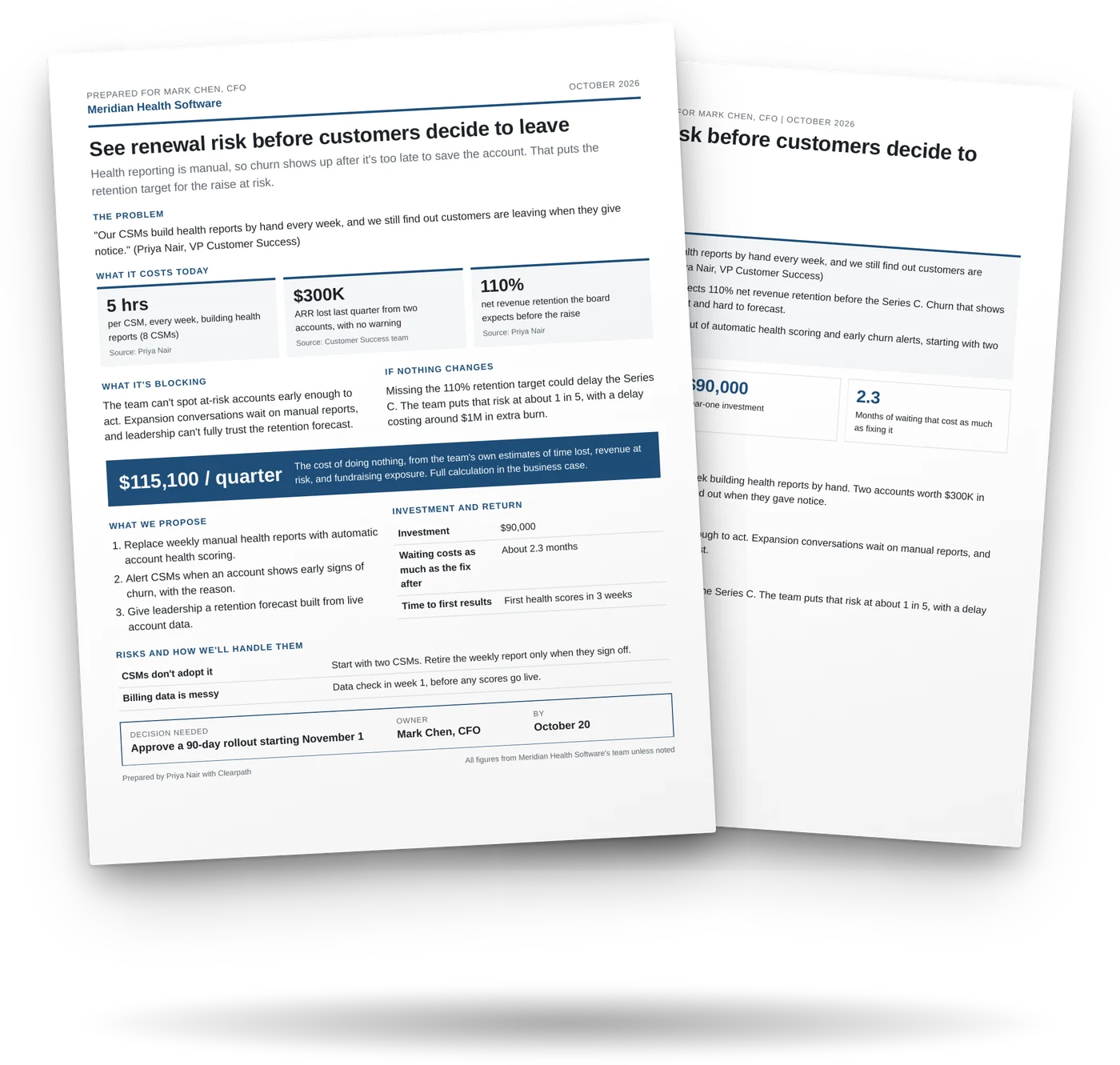
Eight customer success managers. Five hours a week each. A report rebuilt by hand.
If you sell software that makes that work easier, the business case seems to write itself.
Multiply the hours by a loaded hourly cost. Multiply again by the working year. Put the number in a slide. Compare it with your price.
$110,400 — of labor capacity. Not cash. Not savings. Keep that distinction; the whole case turns on it.
It is also where the seller needs to slow down.
What, exactly, is being saved?
The arithmetic uses eight people, five hours a week, $60 an hour and 46 working weeks. It describes labor capacity represented by the current work.
It does not establish that the business will spend $110,400 less.
Nobody has said that salaries disappear. Nobody has measured how much of the work the proposed product removes. Nobody has confirmed what the team will do with the released time.
The time may still be valuable. Capacity can matter. But capacity, cash savings and revenue are different claims, and the buyer deserves a case that keeps them separate.
An AI tool can make the original slide look convincing in seconds. That does not answer the question.
A better question follows something the buyer actually said
In the case, the buyer mentions another detail: when reports run late, an outside operations team sometimes gets pulled in to help.
That creates a useful connection to investigate.
“You said the outside team gets pulled in when reporting runs late. Which part of that spend could actually change if the reporting work improved?”
This is a Playback: start with the buyer's words, connect established facts, ask about the missing implication and let them correct you.
Maybe no spending changes. Maybe the useful effect is somewhere else. Both are legitimate answers.
Here, the anonymised Finance discussion identifies $120,000 of annual contractor spend. A possible 50% reduction becomes an assumption to test. At 80% realization and a two-month delay, the model produces $40,000 of first-year benefit.
Now include the $24,000 license, $6,000 implementation cost and $3,600 internal running cost.
First-year net cash: $6,400 — and negative $8,600 at 50% realization. A smaller number that tells the truth beats a big one that does not.
Use it on your next opportunity. Starter is $37 $47 until October 13 — then the founding price is gone. Complete is $197, once.
At 50% realization, the same case is negative $8,600.
A smaller number can lead to a better decision
The corrected case does not say “obviously buy.”
It says: check the tasks that can actually change, validate the reduction assumption and understand what adoption requires.
That gives Finance something useful to assess. See the full worked example →
It gives the seller a specific next request. It gives the contact a document that can survive a closer look.
The figures are anonymised. The distinction is the lesson.
The same gap appears in deals without an ROI spreadsheet
Your contact says the CFO supports the project. What has the CFO seen?
The opportunity has a close date. Whose event created it?
The team likes the demo. What decision are they now able to make?
You can capture a real operational problem and still leave the business effect or priority untested. You can also write those missing layers yourself, then forget which parts came from the buyer.
I call that the Layer 1 Trap. Better writing does not repair the missing connection.
Three-Layer Playback gives you a way to investigate it: operational facts, business effects, and a reason to act, with confirmed facts, hypotheses and unknowns kept visible.
Put the method on one opportunity
Dominating SaaS with AI turns this into a working sequence: prepare, rehearse, apply, update the case and choose the next decision.
There is a working sequence for building that kind of case. The paid value is the organized work: annotated cases, answer standards, reusable AI instructions, workbooks and buyer-document tools.
You can inspect the example and read or watch the sales presentation before deciding. Neither requires pretending that every deal has a hidden million-dollar problem.
Sometimes the right move is a stronger case. Sometimes it is a smaller test. Sometimes it is to stop.
See the method and compare the two digital options.
See the method and compare options Start with Starter — $37Founding price ends October 13. Then it’s $47.